
Week 11 lecture is based around data, information and knowledge and how they are all related. Data is factual, non judgmental and has no intrinsic value or meaning. Data is often in the form of statistics and measurable data such as the weather or share prices. Information has meaning, is relational, summative but has uncertain value. Information has more written work then data as information would generally summarize data. Knowledge is judgmental, subjective and is very valuable. Knowledge has more written work then both data and information.
The relationship between data, information and knowledge:
• Data – individual facts or proposition. On their own they have little value but can build into information.
• Information – a collection of facts that establishes trends and precedents in order to generate.
• Knowledge – how human experience and wisdom in applied to information in order to make sense of it.
Workshop
The workshop activity for week 11 is defining the words 'data', 'information' and 'knowledge'. I found the definitions at www.dictionary.com.
Data
1. a plural of datum
2. (used with a plural verb ) individual facts, statistics, or items of information: These data represent the results of our analyses. Data are entered by terminal for immediate processing by the computer.
3. (used with a singular verb ) a body of facts; information: Additional data is available from the president of the firm.
Information
1. Knowledge derived from study, experience, or instruction.
2. Knowledge of specific events or situations that has been gathered or received by communication; intelligence or news. See Synonyms at knowledge.
3. A collection of facts or data: statistical information.
4. The act of informing or the condition of being informed; communication of knowledge: Safety instructions are provided for the information of our passengers.
5. Computer Science. Processed, stored, or transmitted data.
6. A numerical measure of the uncertainty of an experimental outcome.
7. A formal accusation of a crime made by a public officer rather than by grand jury indictment.
Knowledge
1. The state or fact of knowing.
2. Familiarity, awareness, or understanding gained through experience or study.
3. The sum or range of what has been perceived, discovered, or learned.
4. Learning; erudition: teachers of great knowledge.
5. Specific information about something.
6. Carnal knowledge
Understanding the relationship between data, information and knowledge is useful to know at university. This is because when researching a topic for an assignment you need to do a lot of research and most of that research should be on finding data, then information then your knowledge from the research you have done can be added.
Five organizations that rely on data, information and knowledge from customers.
1. Banks- To give customer better service.
2. Transperth- To see where busses and trains are needed.
3. Subway- To give customers what they want, for example more variety of foods and better service.
4. Telstra - for better what there company does and increase customers.
5. Hospitals - to help make patients comfortable when staying in hospital.
Another task for week 11 is to draw a representation of data, information and knowledge using MS Word. Below is my representation.
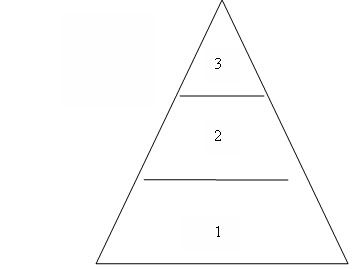
• 1= Data
• 2= Information
• 3= Knowledge
Week 11 Readings
Two of the readings for week 11 describe in different ways the relationships and explanations of the words data, information and knowledge. The website www.systems-thinking.org.dikw.dikw.htm said that data was symbols, information is the data processed to be useful and provides answers to who, what, where when questions, and knowledge is the application of data and information and answers the how questions.
The text written by Tim Mullaney I found was the most useful as I was able to clearly understand the difference between data, information and knowledge. He used an example of how we look at the weather. If the temperature 24 degrees were measured it doesn’t really mean anything other than at a particular place and time it was 24 degrees. But if that data is teamed with more information such as the different temperature all year round it becomes more useful and relationships can be made. From this information knowledge can be formed by making relationships for example from the information given we could assume that in winter temperatures are lower than summer temperatures.
http://camellia.shc.edu/literacy/index.html is a site where you are able to do quizzes which are very useful to UCP0004. The quiz I chose to do was on evaluating the world wide web. These quizzes will be helpful for exam revision.

No comments:
Post a Comment