
When looking for information on the web it can be very frustrating as there is so much information, much of it irrelevant. To quickly find authentic, accurate and relevant information on the web it is useful to use search engines. Search engines search documents on the web for specified keywords and returns a list of the documents where the keywords are found. Typically, a search engine works by sending out a spider to fetch as many documents as possible. Another program, called an indexer, then reads these documents and creates an index based on the words contained in each document.
To use a search engine efficiently it is best to read the tips or help information on each search engine. When searching a topic it is best to use several key words in the search to narrow the search down. It is also recommended to use the different search tools to also help with narrowing down the search.
The problems with search engines are that they don’t filter out outdated information; there is no way to limit lower rank pages and broken pages are still included in searches.
There are large numbers of different search engines interfaces which you can use. Some of them include:
• Turbo 10
• Dogpile
• Excite
• MSN search
• Go Network
• Clusty
• Web Wombat
All search engines help with finding the relevant information you are looking for, with some providing different tools to one another. It is for this reason that you should chose a search engine which you feel most comfortable using.
Workshop
The task for week 9 is to visit http://monash.com.spidap.html and list four strategies that will help with structuring a good search, these include:
1. Keep the search precise.
2. Use + - in the search to limit unnecessary information.
3. Using “ ” will help in narrowing what you want.
4. Putting certain words in characters will limit the search as words such as NOT will tell the search engine you do not want something.
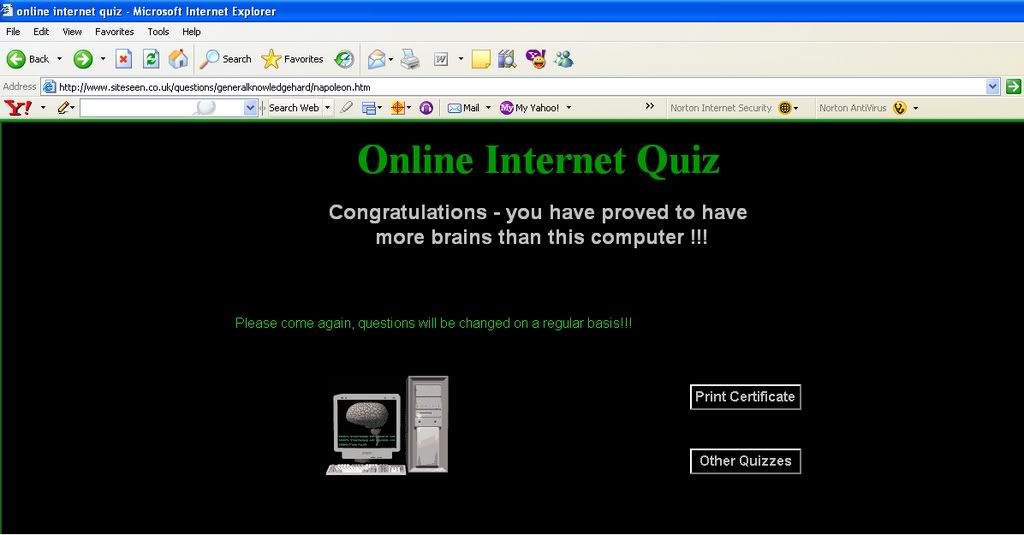
The second task is to complete an online internet quiz found at http://www.siteseen.co.uk/questions/generalknowledgehard/. There are 20 questions which need to be researched by using a search engine to find the correct answer. You must get the correct answer before you can move on to the next question.
The image below is of my results sheet
Readings
There are four different readings provided in week 9 with each of them going into different aspects of search engines. The site http://www.virtualsalt.com/howlook.htm explains why search engines are necessary as the web is so large and finding relevant information can be very difficult without a search engine. The second site http://www.monash.com/spidap.html gives a helpful guide on the most efficient way to search. For example they say that using several key words will help with finding the most useful information on the topic you are looking for. http://searchenginewatch.com/resources/article.php/2156611 is a site also gives information on how to use search engines better. This page provides a guide to key material within Search Engine Watch, resources across the web and articles written about searching better. The final readings come from the site http://www.let.leidenuniv.nl/history/ivh/chap4.htm, this site gives information on search engines, data bases, directories, a brief history of the web, library catalogs and how to find information on the net. All sites are very useful in providing useful information on search engines and how to use them efficiently.

No comments:
Post a Comment